

Recoleta Cemetery: History, Mausoleums and How to Visit
What to see at Recoleta Cemetery in Buenos Aires: its history since 1822, the must-see mausoleums, its legends and how to visit.
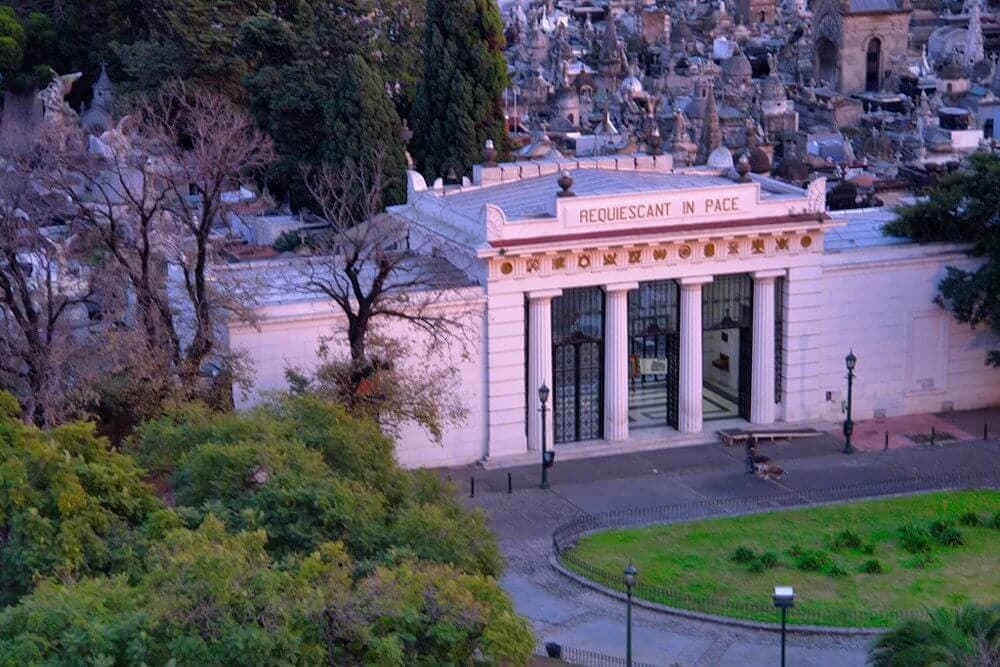
An Open-Air Museum in Buenos Aires
Some cemeteries are walked with the head bowed. Recoleta is walked with the head held high, looking up. Its marble streets look like a miniature city: domes, angels, columns, stained glass. Every vault tells a story, and no two are alike.
It sits in the heart of the Recoleta neighborhood, next to the Basilica of Our Lady of the Pillar, and is one of the most visited places in Buenos Aires. Many people arrive looking only for Evita's tomb and end up staying for hours, lost among the passageways. This is not a place to rush through.
From 1822 to Today: How Recoleta Began
The cemetery opened on November 17, 1822, the first public cemetery in the city. The original layout was drawn by French engineers and architects, among them Próspero Catelin. Almost sixty years later, in 1880, Juan Antonio Buschiazzo renovated it: he raised the walls, organized the streets and designed the neoclassical portico with Doric columns that greets visitors today. Above the entrance, in Latin, you can read Requiescant in pace: may they rest in peace.
It was not always a symbol of prestige. It began on land belonging to the old Recoletos convent, in what was then the outskirts of the city. Only over time, with the great families vying for a place, did it become the most coveted address for eternity.
Over the years, the country's most powerful families competed to have the most impressive vault there. That rivalry, half pride and half love, left a unique heritage. In 1946 the cemetery was declared a National Historic Monument, and more than ninety of its vaults now enjoy that same protection.
The Mausoleums You Have to See
The most sought-after tomb is that of Eva Perón, in the Duarte family vault. It is understated, almost modest for the myth it holds. For security reasons, her crypt was built several meters underground.
But Evita is only the beginning. Recoleta is the resting place of national heroes, presidents and scientists: Domingo Faustino Sarmiento, Bartolomé Mitre, Julio Argentino Roca, Carlos Pellegrini, even Nobel laureate Luis Federico Leloir. Each vault belongs to its era. Art nouveau, art deco, Gothic revival and baroque live side by side within a few blocks, so walking its passageways means traveling through two centuries of architecture.
What surprises most is the variety. Next to a miniature Greek temple stands a neo-Gothic chapel, and right after it a clean-lined art deco facade. Many of the sculptures are the work of renowned artists: weeping angels, praying figures, bronze portraits. It is no exaggeration to call it one of the most important funerary art museums in the region.
To find the most notable ones, look for the elaborate facades, the marble and the signed sculptures. It is a good idea to pick up a map at the entrance. And if you get lost anyway, don't worry: getting lost in Recoleta has its own charm.
Legends That Live On
A cemetery this old keeps its stories. The most famous is that of Rufina Cambaceres, the young woman who, as the story goes, was declared dead and buried alive. Her art nouveau mausoleum is now one of the most photographed in the place. Other tales speak of hidden passageways, of statues that seem to follow you with their gaze, of loves that never had time to end.
None of these stories needs to be entirely true to be part of the place. They are told in whispers, from guide to visitor, and so they live on, generation after generation.
It is worth approaching these stories with curiosity and respect. They are as much a part of Recoleta as the marble. Walking calmly, without touching or altering anything, is the best way to listen to them.
How to Visit
The cemetery is open every day, generally from 9 a.m. to 5 p.m., although it is best to confirm the hours depending on the season. Admission is free for Argentine residents; foreign visitors pay an entrance fee, so check the current price before you go.
Free guided tours in Spanish leave from the main entrance several times a day. If it is your first time, they are worth it: a guide shows you what you would otherwise walk right past. Wear comfortable shoes, bring water and, if it is sunny, something for your head. And choose a quiet hour, early or at dusk, to have it almost to yourself.
Getting there is easy: it is in the Recoleta neighborhood, next to the Basilica of Our Lady of the Pillar and the Recoleta Cultural Center, an area that invites you to keep walking afterward. If you are coming from far away, give the cemetery at least an hour. Whoever gets caught up in it stays two.
Carrying the Memory Further
Recoleta teaches something simple: remembering is also an art. Every family that built a vault wanted the same thing, for their loved ones not to be forgotten. Today that gesture no longer needs marble.
On Cementerio.com you can create a free digital memorial to gather the photos, dates and stories of the person who has passed, and share it with your family wherever they are. A place to come back to, no matter the distance.