

Always alive as long as someone remembers them
Pixar's Coco reveals a truth ancient cultures already knew: the final death is not the body's, but forgetting. And there is something concrete you can do today to prevent it.
There is a death that never appears in the obituaries
The first death comes with the last heartbeat. The second, when the body returns to the earth. But there is a third, and it is the only one we can prevent: the final death. The one that arrives when the last person who remembers you also forgets your name.
Pixar captured this in a way few films manage to. Coco is not a story about skulls and marigolds. It is a story about what we do, or fail to do, so that the people we love do not die a second time.
Final death: the real antagonist of Coco
In the Land of the Dead in the film, spirits exist for as long as someone among the living remembers them. They have a photograph on an ofrenda, someone who says their name out loud, someone who tells a story about them at the Christmas dinner. When that thread is cut, the spirit fades away. There is no drama and no warning. They simply cease to be.
Héctor was on the verge of that disappearance. Not because he was a bad person, but because the chain of memory linking him to the living was about to break. A single person, Mamá Coco, elderly now and with a fragile mind, was the last link.
That is what makes the film's most moving scene hit so hard:
When Mamá Coco remembers, when she smiles and says "Papá", Héctor does not only survive in the Land of the Dead. He survives in everyone who comes after. Because Mamá Coco did not take the memory with her when she died. She passed it on.
The living chain of memory
What lets a memory outlive the person who carries it? The film has an answer, though it never states it outright. The memories that last share something: they are a chain, not an island.
Passing it on has to be active. It is not enough for the information to exist in a book, a film or a Wikipedia page. A memory has to be part of a chain of living people who tell it, repeat it and make it their own. A fact is not a memory. A memory is a story that someone chose to tell.
The origin matters. For the chain to work, someone who knew the person directly has to be the first link. Once that person shares their memories, those who hear them can keep passing them forward. But if that original link is lost without speaking, the chain has nowhere to begin.
Love is the engine. A family does not only keep stories; it keeps them with love. There is an enormous difference between remembering the facts about a person and remembering their whole life: how their clothes smelled, how they laughed, what they did when they were nervous. Love turns an anecdote into a living person in someone else's memory. Mamá Coco did not keep only the facts about Héctor. She kept Héctor.
The ofrenda: a three-thousand-year-old technology for the same problem
The cultures that developed the Day of the Dead knew this long before cinema existed. Forgetting is the true enemy of the dead. And they built a ritual to fight it.
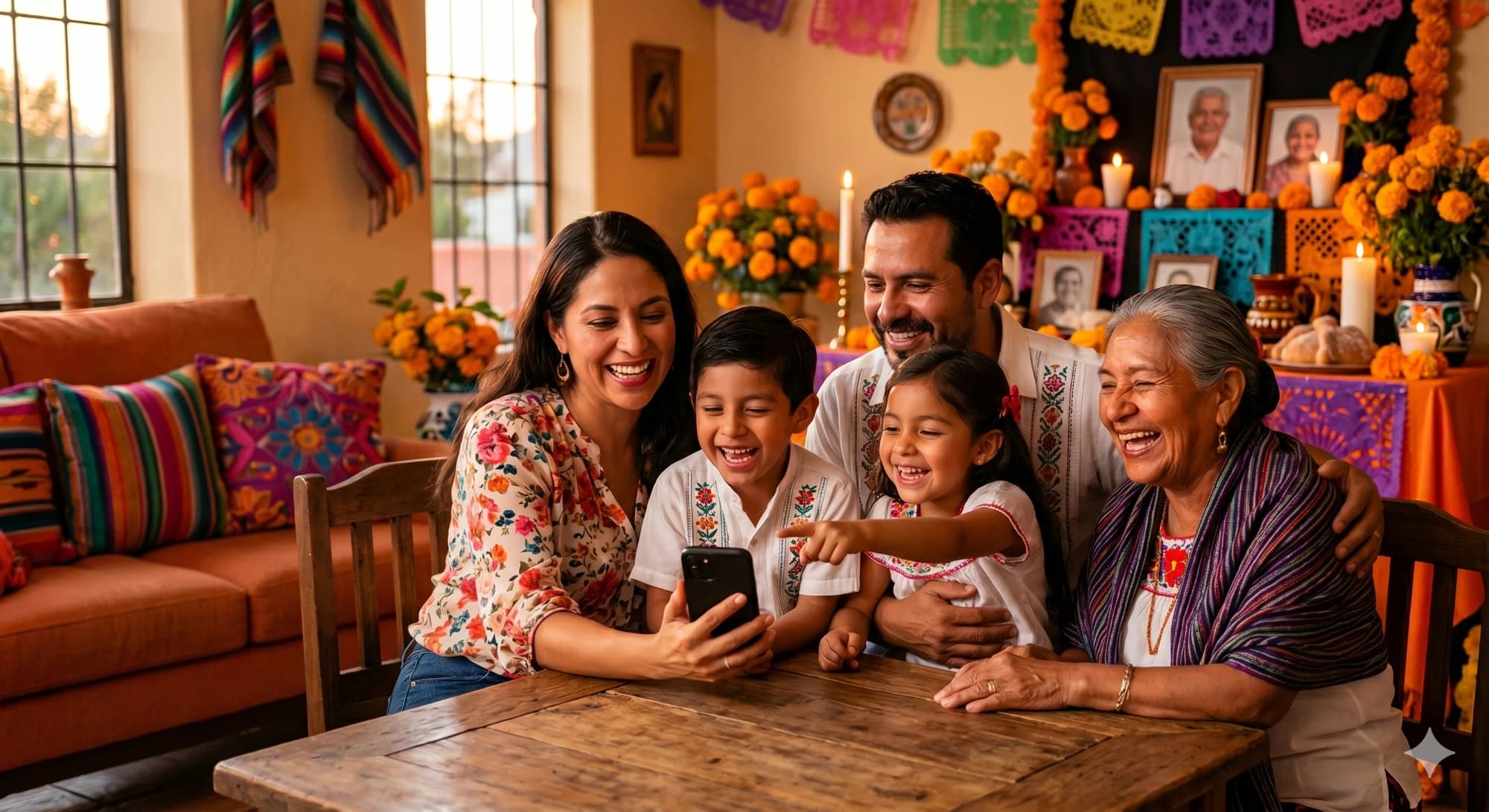
The ofrenda is not decoration. It is a system. Photographs put a name to a face. Marigold flowers guide the spirits home with their scent. Candles light the way. The pan de muerto, the favorite dishes, the objects they loved: each element calls up a detail, a story, a "remember when...?"
What the ofrenda does is create a moment of collective memory. The family gathers around it and remembers out loud. That is exactly what the living chain of memory needs in order not to break.
As the film puts it: "no one truly dies as long as someone remembers them". The ofrenda exists to make sure there is always someone.
From the altar of flowers to the digital memorial
The challenge with ofrendas is that they last a day. The altar goes up on November 1 and comes down on November 2. Children grow up, families scatter, cities change. The chain grows thinner without anyone noticing, without anyone deciding it.
A digital memorial is, in essence, a permanent ofrenda.
Photographs that might deteriorate on an altar over the years remain in a digital memorial. Stories that once depended on someone telling them at a family gathering can now be written down so that those not yet born can read them too. The chain no longer depends on everyone being in the same place at the same time.
At SerQuerido, each memorial is that meeting point. A place where the family can leave flowers, read what others remember, and receive a notification when the anniversary approaches. Not to bring the pain back, but so the memory is not lost in the rush of the days.
The flowers you send on SerQuerido have something of the marigold in them. The anniversary reminder has something of the ofrenda. They are modern ways of doing what cultures have always known how to do: gather, even if digitally, around the one who is no longer here.
What you can do today
Héctor came close to dying for good because he depended on a single link. Mamá Coco. And Mamá Coco was growing old.
The question is not whether the people we love will be forgotten someday. The question is when that process begins, and what we do today to delay it.
A memorial is not an act of sadness. It is an act of love toward the future. It is telling those who come after: this person existed, mattered, and deserves to be remembered.
Create a memorial for your loved one. Add their photo, their story, the dates you do not want to forget. Invite your family to leave their flowers. And when the anniversary comes, SerQuerido will remind you.
If Pixar got it right, the living chain of memory does not break on its own. Silence breaks it. And silence has a cure.